DEEPTOKYO
magazine

EN


AREA
DEEPTOKYO
magazine
EN
AREA

For more than a century, Bunka Fashion College has helped shape fashion education in Japan from its campus in Shinjuku, Tokyo. Known internationally simply as BUNKA, the school has produced generations of influential designers, including Kenzo Takada, Yohji Yamamoto, Jun Takahashi, and NIGO®. Here, rigorous technical training is matched by outstanding facilities and a student community that brings together perspectives from around the world. From learning the fundamentals of garment making to opportunities to present their own work to a wider audience, students have an ideal environment in which to learn, create, and grow.
SHARE


Founded in 1919 as a small dressmaking school, Bunka Fashion College became Japan's first officially recognized institution for fashion education in 1923. For more than a century, it has played a leading role in fashion education in Japan. Today, alongside internationally renowned schools such as Central Saint Martins in the UK and Parsons School of Design in the United States, BUNKA is regarded as one of the world's foremost institutions for fashion education. Known simply as BUNKA in the global fashion community, the college attracts students from around the world.
Bunka Fashion College is part of Bunka Gakuen, an educational institution that also includes Bunka Fashion Graduate University, Bunka Gakuen University, and Bunka Institute of Language. Its long campus buildings stretching along Koshu Kaido make a striking impression.
Taken in 1930. When the school was founded, kimono was still commonly worn as everyday attire in Japan, and opportunities to study Western dressmaking in a systematic way were limited.
A major curriculum reform in 1980 established three departments: the Fashion Creation Department, the Fashion Technology Department, and the Fashion Marketing and Distribution Department. The Fashion Accessories and Textiles Department was added later, completing the four-department structure that continues today.
One of the reasons BUNKA has earned worldwide recognition is the remarkable success of its graduates. Among them are Kenzo Takada and Yohji Yamamoto, pioneers who brought Japanese fashion to the international stage, as well as Jun Takahashi of UNDERCOVER, NIGO® of HUMAN MADE, Ryota Iwai of AURALEE, and Hiromichi Ochiai of FACETASM. These are just some of the many BUNKA graduates whose work continues to earn recognition in Japan and around the world.
What connects these designers is not a single aesthetic, but a shared willingness to redefine fashion from their own perspective rather than simply following Western fashion. Japanese fashion has long drawn its strength from the free mixing of different cultures—high fashion and streetwear, tradition and innovation, music, anime, and subculture. It transforms the character of materials, sculptural silhouettes, and even the subtle tensions and moods of everyday life into clothing. That creative freedom is one of the reasons Japanese fashion continues to captivate audiences around the world.
At BUNKA, however, creativity alone is never enough. Students are taught the technical skills needed to turn original ideas into garments people can actually wear—and to make those ideas work as a business. This rigorous approach to technical education has helped students develop their talent and creative expression, producing generations of accomplished designers.
Jun Takahashi launched UNDERCOVER with classmates while studying in the Apparel Design Course.
BUNKA's expansive campus, with 20 floors above ground and one below, is home to a wide range of facilities where students can gain hands-on experience in the skills and knowledge of fashion. There are also spaces where students can explore materials and resources that inspire new ideas. This extensive learning environment is one of the college's greatest strengths.
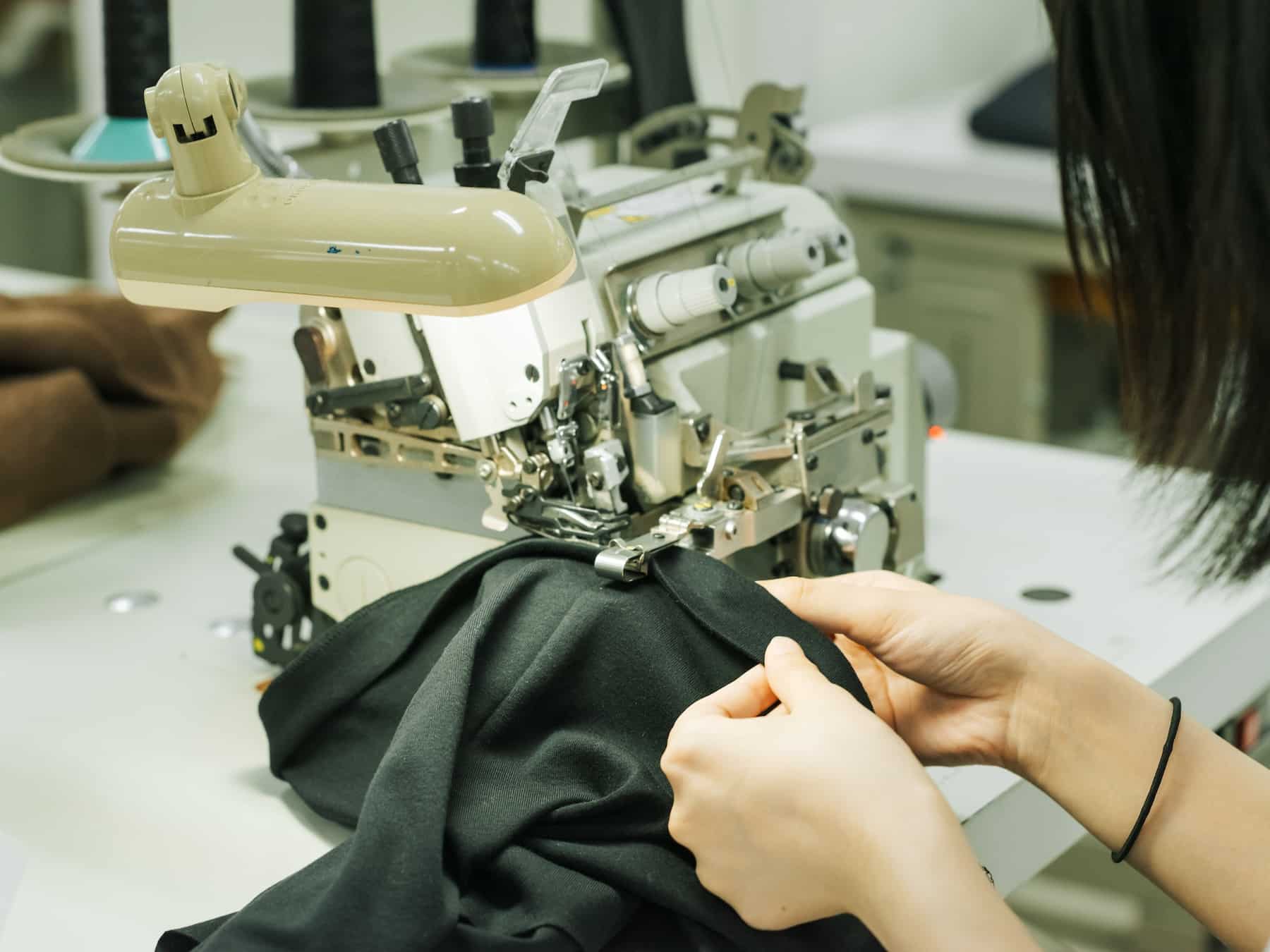
In the Production Management Workshop, for example, students gain hands-on experience with the production process for ready-to-wear garments, using industrial sewing machines, automated cutting equipment, and more. The Textile Printing Workshop, meanwhile, allows students to create fabrics themselves, from designing patterns and preparing screens to dyeing materials.
Rows of industrial sewing machines and pressing equipment fill the Production Management Workshop, giving the space the scale and feel of a professional garment factory.
Students train with more than 120 industrial lockstitch sewing machines, as well as automated cutting machines, welt-pocket sewing machines, button-sewing machines, and other specialized equipment.
Large silk-screen printing equipment in the Textile Printing Workshop.
Students place fabric and screens featuring their own designs onto heated printing tables, then print each piece by hand.
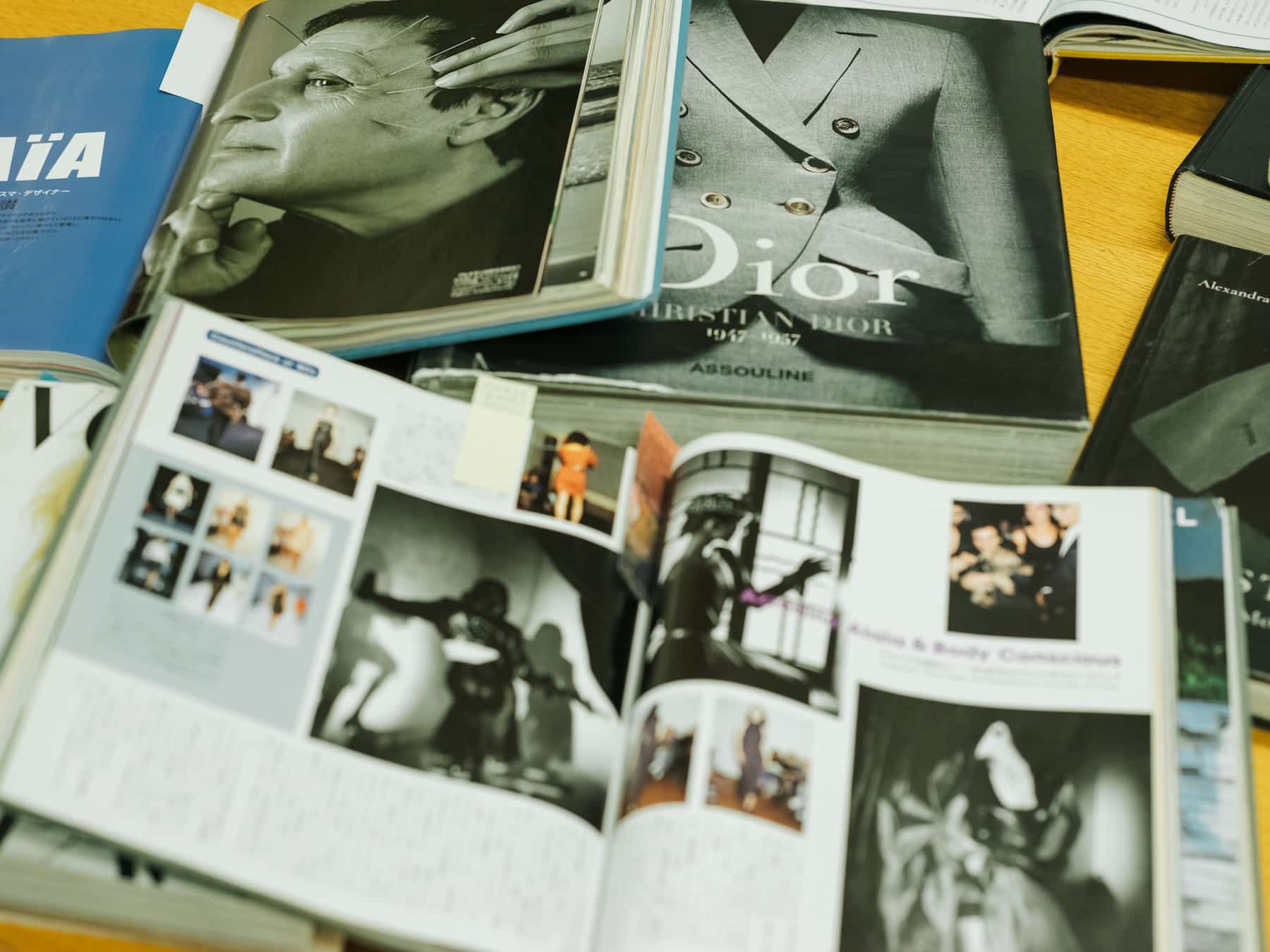
The Bunka Gakuen Library houses an extensive collection of books on fashion history and design, as well as fashion magazines from Japan and around the world. The Fashion Resource Center preserves student work and archives of alumni designers. With access to a wealth of reference materials and actual garments, students can find inspiration and develop new ideas for their own work.
The latest issues of fashion magazines from Japan and around the world line the shelves of the Bunka Gakuen Library.
The collection ranges from specialized books on costume history, ethnic dress, design, garment construction, crafts, and textiles to collection books from major fashion brands, photography books, and designer biographies.
The library holds approximately 3,400 magazine titles, including international editions of VOGUE and ELLE, as well as Japanese fashion magazines such as ViVi and non-no. Back issues are bound by year for archival storage.
Magazine indexes are organized by designer, making it easy to identify the relevant magazine and issue.
The costume archive at the Fashion Resource Center preserves pieces once presented by students in fashion shows, alongside garments by alumni designers, in a museum-like setting.
The collection extends beyond clothing to include headpieces, footwear, and other fashion accessories.
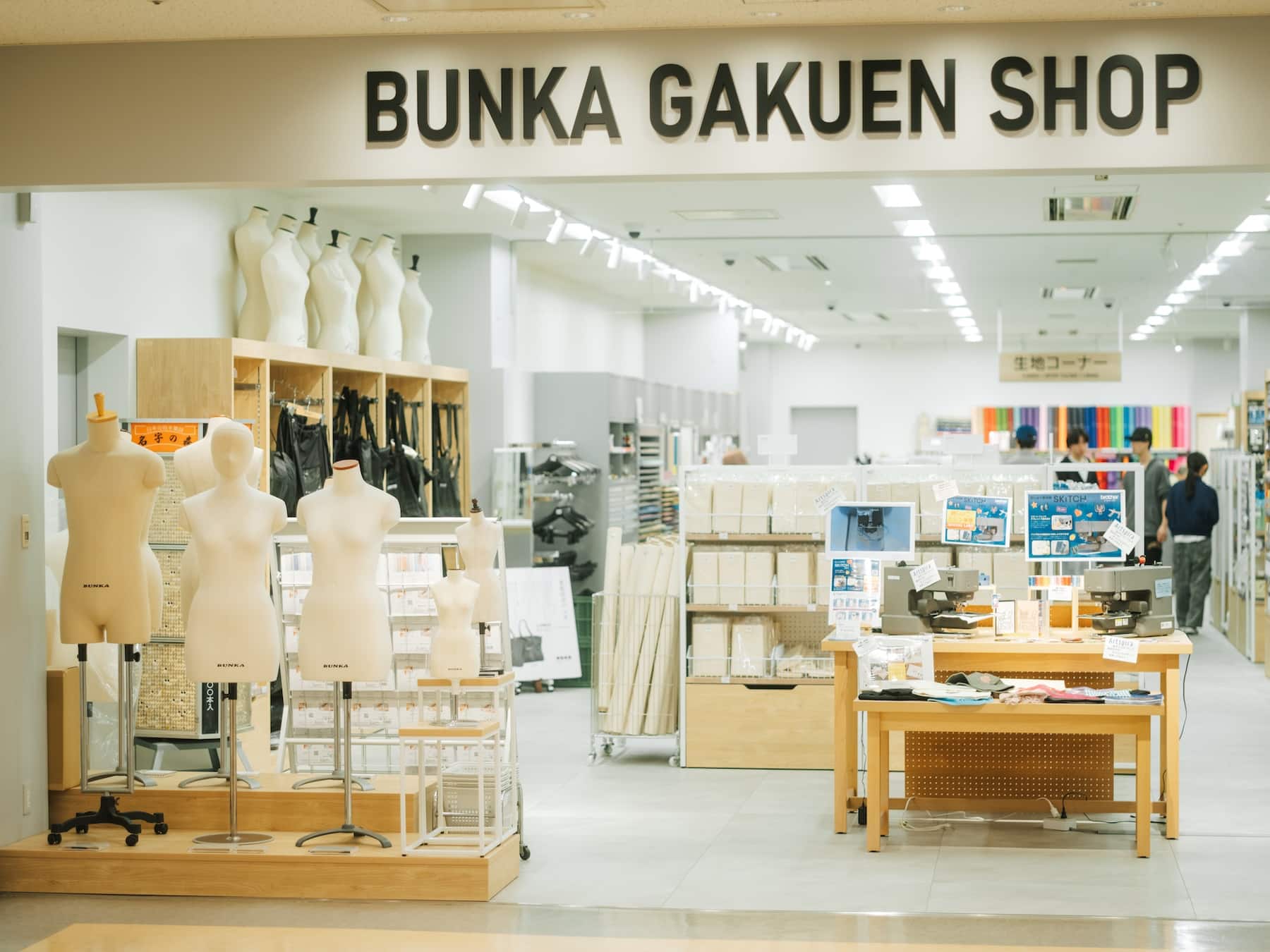
Students can also purchase fabrics, notions, art supplies, dress forms, and other materials at the campus store.
From hands-on training and research to sourcing materials and tools, everything students need to study fashion at a professional level is available on a single campus. This comprehensive learning environment is one of BUNKA's greatest strengths—and one of the reasons students can continually refine their technical skills.
The campus store carries fabrics, buttons, zippers, dress forms, and other materials used in class projects. Having the tools and materials they need close at hand helps students make the most of the limited time they have to complete their assignments.
The campus store even has veteran staff who have been supporting students' creative work for more than 40 years.
Including the campus store, BUNKA has four fabric shops on campus, each offering a different selection of textiles.
Today, international students make up around 30 percent of the student body at BUNKA. Among them is Macarena, a student from Spain.
Macarena is now in her third year in the Apparel Design Course, where she is developing her creative skills with the goal of becoming a designer who works internationally. Her journey to BUNKA began at the age of 13, when she saw BUNKA's graduation fashion show on YouTube and decided that this was where she wanted to study.
“I see myself less as a designer and more as an artist who expresses herself in different ways. I had practiced drawing and photography on my own, and I also attended an arts-focused high school in Spain, where I learned different ways of expressing myself. But making clothes was something I'd always wanted to try, and I felt it was something I needed to be properly taught. “The BUNKA show I saw online was a huge shock to me. The clothes were unlike anything I'd ever seen in Europe. Seeing the students wearing what they loved and expressing themselves so freely made me think, ‘I want to go there too!’” (Macarena)
Macarena is a third-year student in the Creative Apparel Design Course, part of the Fashion Technology Department.
Macarena bought her Bob Marley T-shirt at Rhythm9 in Shimokitazawa.
BUNKA does not offer separate courses or classes for international students. International and Japanese students study together in the same classrooms, and all classes are conducted in Japanese. International students therefore need to develop a solid command of Japanese before enrolling, often by attending a Japanese language school.
“My closest friends are from other departments. We met during my first year, and they’re from Japan, Korea, and Canada. There are people here from so many different backgrounds, with all kinds of perspectives and values, and I find that incredibly inspiring. I don’t think you’d find an environment like this at any other school.” (Macarena)
Now in her fourth year in Japan, Macarena says the fastest way to improve your Japanese is simple: “Go out, don’t be afraid to speak Japanese, and make friends!”
Students in the Apparel Design Course, where macarena studies, spend their first year learning the fundamental knowledge and techniques of garment making. Over the following two years, they create their own work while developing their creativity and refining their expressive skills.
BUNKA offers 26 specialized programs and courses covering a wide range of fields within fashion. Some prepare students to become designers or pattern makers, while others focus on styling, modeling, fashion promotion, and retail. Yet across almost every course, one subject remains essential: learning how to make clothes. Understanding how garments are constructed is a fundamental skill, no matter which path students choose within the fashion industry.
A garment construction class. Students begin by choosing a creative theme for the year, then work through assignments such as jackets, cut-and-sew tops, and coats, developing the design, selecting materials, and making each piece themselves.
Macarena hand-sews sequins one by one around the cross motif on the back of a cut-and-sew top.
Her sketchbook, filled with design drawings. Students in the Apparel Design Course also develop the visual communication skills needed to convey their ideas through these drawings.
Some of Macarena's past creations. She says much of her inspiration comes from the mysteries of nature and the culture of her native Spain.
This emphasis on hands-on learning reflects BUNKA's approach to education: students are expected to thoroughly develop their technical skills rather than relying on creative instinct alone.
Around 90 percent of incoming students have no previous experience in garment making. To support them, the college uses a homeroom teacher system, allowing instructors to closely guide each student according to their individual progress.
“I love talking with my teachers. It makes me really happy that they listen to what I’m trying to express and take the time to look at my work. Sometimes they give me honest feedback or suggest new ideas. It’s really reassuring to have them there.” (Macarena)
Homeroom teachers closely support each student throughout the creative process—from teaching sewing techniques and how to use different tools to offering advice when projects stall and guidance on future career paths.
At BUNKA, creating garments is only part of the experience. Students are also given numerous opportunities to present their work to an audience. Runway shows featuring student creations are held during the annual School Festival and as part of the graduation projects required by most departments. The school also actively supports students who wish to enter competitions both within and beyond the college.
Among these events, the School Festival Fashion Show stands out as one of BUNKA's signature traditions. Around 700 students take the lead in producing the show, handling everything from designing and making the garments to stage production, lighting, sound, direction, modeling, and event management.
Students also have many opportunities to take part in competitions both within and outside the college, including ”individual,” the Selected Student Collection, and the Soen Award. Faculty members provide extensive support to those who wish to participate, including detailed feedback on their work.
For the School Festival Fashion Show, leading names in Japan’s fashion and textile industries, including YKK and Toray, provide materials to support student creations. This industry involvement helps students further enhance the quality of their work.
Designers selected for last year's ”individual” collection also had the opportunity to present their work at an event affiliated with Rakuten Fashion Week TOKYO, one of Japan's largest fashion events.
Creating a fashion show requires far more than designing clothes. Students collaborate across departments with people specializing in pattern making, modeling, hair and makeup, stage direction, and more. These projects not only give students opportunities to present their work to a wider audience, but also let them experience the excitement of working with others to bring ideas to life and gain a taste of what it is like to work in a professional fashion environment. All of this helps motivate students to push their work further.
The campus bulletin boards feature information on competitions organized by the college, local governments, and others. Students can enter competitions across a wide range of fields, including fashion, jewelry, and leather goods.
BUNKA offers more than a place to study fashion. It is a place where students are encouraged to develop their own creative vision while mastering the technical skills needed to bring that vision to life. They have access to outstanding facilities, work alongside classmates from around the world, and are given opportunities to present their creations beyond the classroom. Together, these elements give students what they need to build a future in fashion. That is why students from around the world continue to choose BUNKA. At its campus in the heart of Shinjuku, students from different countries and cultures inspire one another as they immerse themselves in fashion every day.

A third-year student in the Apparel Design Course from Spain, macarena also performs as a DJ. Interested in art from an early age, particularly drawing and photography, she hopes to pursue a career as an artist. After moving to Japan, she attended a Japanese language school for about a year and nine months and passed N2 of the Japanese-Language Proficiency Test (JLPT). Her favorite neighborhood in Tokyo is Sangenjaya.

Japan's first fashion college with a history spanning more than a century. The college is organized into four departments: the Fashion Creation Department, where students learn everything from the fundamentals to advanced techniques in garment making while developing a broad understanding of fashion; the Fashion Technology Department, where students develop advanced garment-making skills and prepare to become specialists in the apparel industry; the Fashion Marketing and Distribution Department, focused on apparel business and distribution; and the Fashion Accessories and Textiles Department, for students pursuing careers in textiles and fashion goods. Together, the four departments offer 26 specialized programs and courses.